
Ginseng for Weight Loss

The bottom line
There's no magic way to lose weight without a sensible diet and regular exercise. Research on Asian ginseng is still limited: most clinical trials have been small and shorter than 3 months, and the majority of research shows that it does not improve athletic performance.
This is general information, not medical advice. Ask your doctor or pharmacist about your own situation.
Key takeaways
- If you have diabetes, consult your health care provider before using Asian ginseng, because it might lower blood sugar levels.
- Some experts recommend against Asian ginseng for infants, children, and women who are pregnant or breastfeeding.
- Asian ginseng may worsen autoimmune disorders and interfere with blood clotting.
- Unlike drugs, dietary supplements are not approved by the FDA before they are sold to the public.
- Siberian ginseng is a different plant: it does not belong to the genus Panax.
Ginseng comes with a lot of medicinal benefits. Ginseng health benefits also include weight loss. Wondering how & why?
In this article, I will take you through various interesting facts about Ginseng, all its health benefits and also how Ginseng helps in weight loss.
Many herbs provide significant health benefits, but Ginseng tops the list.
Especially in China, this is the most important healing herb. So much so, that in ancient times, it has also ignited wars over the custody of its farms.
Ginseng cultivation has been carried out for more than 100 years. Now, people consume it in many parts of the world.
What is Ginseng?
Biologically or Botanically, Ginseng can be named to any of the 11 slow growing, perennial species of the plants in Panax genus.
There are many types of Ginseng found on this planet, but I will talk about the most important ones.
Brief Ginseng History?

Ginseng was anciently grown and produced in China. There are written records about the fact that Chinese people used this as their herbal medicine.
Major producers of Ginseng are Korea, America, China, and Canada while others are India, Vietnam, Siberia.
About half of the Ginseng supplied in the markets, comes from South Korea. The largest consumer of this herb is China. While Asian and American Ginseng is real, Siberian Ginseng is considered to be an adapted one.
This medicinal and nutritious herb have derived its name from its resemblance to a human figure. The roots of this plant are similar to human. They are forked and plumply.
Because Siberian Ginseng is different from Asian and American ones, it has more wood like roots that are comparatively harder and with less medicinal value. It does not even belong to the genus Panax but is of the same family.
What does Ginseng look like?

The most interesting part of Ginseng are its roots. Also, the most nutritious and medicinal part are the roots.
Ginseng keeps changing its appearance with growth. Initially, it has three leaves, and as it grows, it might have four or five leaves.
Ginseng is a perennial plant with growing erect for about 8 to 15 inches in height from the ground level.
I will divide it into three parts, the leaves, flowers and fruits, and roots because every part of this plant holds much of curative importance.
Leaves

Ginseng plant looks very different in the first year. It has only three leaves. They look more like Strawberry leaves. The leaves are oval in shape with rounded or pointed corners.
The leaves are with serrated edges and in one prong there can be three to five leaves. In the first year, there is one prong and three leaves. If you are wondering what a prong is, it is nothing but a set of leaves coming out of the same branch.
In the first year, there is one set, consisting of three leaves. So there is one prong of three leaves. In the second year, there can be two prongs with three, four or five leaves. Not necessarily will the prongs increase, there can also be just one prong with three leaves same as the first year.
Later, this plant produces three prongs with either three, four to five leaves in each prong. In this stage, it flowers and flourishes. Fruits also can be seen at this stage. In this phase the Ginseng also not fully mature.
When it grows to four prongs, it is close to maturity because rarely there is a Ginseng plant that has five prongs. Three leaves that grow in the beginning are bigger than the two leaves or one leaf that grows afterward in a prong. So if a prong has five leaves, three will be larger than the two.
The leaves of Ginseng don’t have much healing value.
Flowers and Fruits

Ginseng plant starts to bloom in the month of July and August. There can be 6 to 12 greenish yellow flowers.
Followed by flowers, there are bright red berries.
Ginseng berries have some medicinal benefits, but not many people prefer to use it. Ginseng berry extract and powder are however used in preparations of some medications.
Roots

Roots of Ginseng are the most important parts of this plant. They have a shape like human figure which is why the name is Ginseng. It means like a human.
This plant has thick, spindle-shaped roots. They are about 2 – 3 inches long or more. They are often branched and with 1 inch of thickness.
In the first year, this spindle-shaped root is simple but after the second year, it becomes forked and branched. This healthy root has a thick, pale yellow or brownish bark, noticeably marked with transverse wrinkles.
The whole root is fleshy and somewhat flexible. After properly drying, it is solid and firm. Ginseng has a slight aromatic odor, and the taste is slightly sweet and mucilaginous.
Where does Ginseng come from?
As I have already mentioned earlier, Ginseng is majorly produced in Korea, America, Canada and China; it originates from these regions apart from some other places as well.
China was the place where the healing benefits of Ginseng were first discovered and put to use.
India, Siberia, Vietnam are also some of the places that produce Ginseng.
Each Ginseng labels as Genus Panax, but Siberian Ginseng is different. Ginseng contains Ginsenosides and Gintonin, but Siberian Ginseng contains Eleutherosides, not Ginsenosides.
Each Ginseng coming from various regions provides same contents, but the quantity differs. Highest quality of Ginseng comes from Korea.
When does Ginseng start growing?
Ginseng is a plant that grows in spring. So seeds are sown before spring and then in spring, it sprouts. The place of growth needs moist air and moderate temperatures to grow. It can not grow in direct sunlight.
So it grows in moist deciduous forests of America. It needs to have a place where there is moist loamy soil, the right mix of shady trees and minimal sunlight.
Majorly this grows on the North facing slopes, less towards the East and West and rarely towards the South facing slopes. It is not seen at the top of the mountains, and always it chooses to grow on the slopes.
If you wish to know whether you can grow Ginseng at your place, I will tell you; it is not easy but not impossible as well. You need to be very sure of its favorable conditions before you plan to plant it.
Ginseng farms can fetch an enormous amount of money to anyone, but it is tough to maintain the temperatures and find the right mix of utilities that are required by this medicinal herb to grow.
Different types of Ginseng and which one is the best?
If you are wondering how many types of Ginseng are there and which one is the best to use, I will make it easier for you.
I have listed down the most popular and influential types of Ginseng here along with a few properties of them.
1. Asian Ginseng or Korean Ginseng
These also known as Chinese Ginseng. It is the best form of Ginseng available and is also the most recommended by herbalists. Korean Ginseng is denser and richer in nutrients than any other variant.
It is rich in antioxidants, vitamins, and minerals. When the Korean Ginseng grows for six long years, it becomes the one of the highest quality. Some of the major benefits include getting the body into shape and boosting the immune system.
Asian Ginseng is a hot stimulant. If you are looking for stress relief, then this is not the one for you. Because there is a difference in the levels of Ginsenosides that these variants contain, the characteristics of each of them differ.
For example, the Ginsenosides Rg1 and Rb1 are contained in similar quantities in Korean Ginseng.
Rg1 is thought to be Central Nervous System stimulant. It is a fatigue fighter and increases mental performance.
Rb1 is a Central Nervous System depressant. It is for more calming and soothing effects. It tranquillizes and eases out the brain and mental functions.
Some research shows that taking Asian ginseng by mouth seems to improve sexual function in people with erectile dysfunction, and a small amount of research suggests it may improve some thinking skills in middle-aged adults.
2. American Ginseng
American Ginseng is of a higher quality than Siberian Ginseng and slightly lower than Asian Ginseng.
The name American refers to the species and not the region of growth because Ginseng can be grown anywhere if favorable conditions are created and maintained.
It is not necessary that American Ginseng can only be produced in America while Korean in Korea. American Ginseng, known as the second best Ginseng, is usually mass produced wherever grown.
This type of Ginseng is mostly for the preparations of medicines because Korean Ginseng is very expensive.
American Ginseng is very beneficial for immune system functioning, cold and flu.
3. Siberian Ginseng
As I mentioned earlier, Siberian Ginseng is the least potent of all of the above. It is still used, not very widely but often to increase energy and vitality.
In North America, it is now illegal to call Siberian Ginseng, Ginseng, because of labeling issues. It is not a valid form of Ginseng.
It is advisable to avoid Siberian Ginseng and opt for American or Asian Ginseng to improve health and mental conditions.
Nevertheless, this variant has shown some anti-viral properties and reduced the number of Herpes in people.
Among all the three types, the best one is Korean Ginseng or Asian Ginseng. It is because of the soil contents that Korea has.
Now that you know enough about Ginseng and its origin let me tell you what are the important benefits of this medicinal herb.
Ginseng Health Benefits
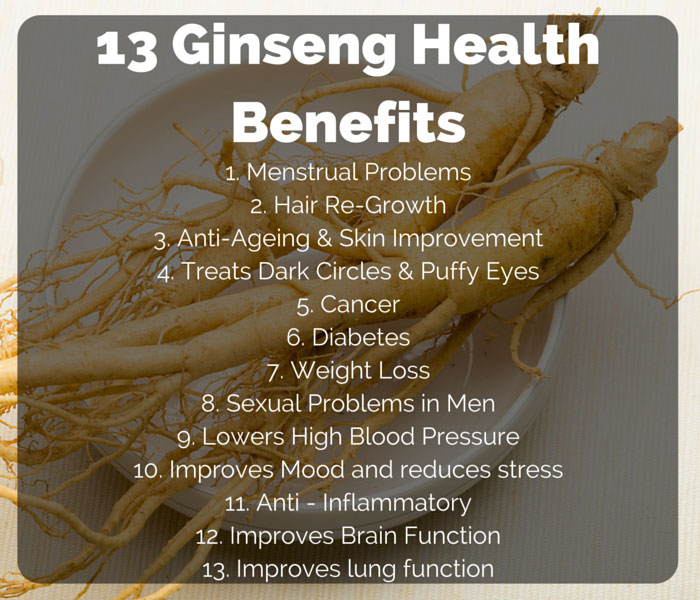
Ginseng is a boon regarding healing benefits that it provides with.
Both American and Asian Ginseng are very useful to provide a boost of energy, lower blood sugar, and cholesterol, sexual dysfunctions in male and stress relief.
1. Menstrual Problems
Ginseng is found very effective in relieving menstrual pain in women. It is believed to provide with calming and tranquillising effects which is why, during menstruation, the spasms are reduced.
Consuming Ginseng Tea during this time relieves pain to significant levels. Also, during the pre – menopausal symptoms, Ginseng is found very useful. It uplifts mood and provides energy apart from reducing pain.
2. Hair Re – Growth
If you are concerned about baldness, I suggest you try Ginseng for hair re – growth. What this medicinal herb does is that it increases the production of dermal papilla cells.
In addition to this, it also increases the life of these cells and prevents the cells from dying. When these cells die, that is when hair loss happens. The proliferation of these cells facilitates by improving the blood circulation in the scalp.
3. Anti – Ageing and Skin Improvement
Ginseng is very helpful in providing anti – aging properties to skin and improving it.
It contains a lot of phytonutrients and anti – oxidants that increase the skin’s metabolism. The anti – oxidants make your skin free of free radicals, leaving it rejuvenated.
Skin is mostly damaged by environmental conditions and sunlight, which further damages the collagen. Ginseng regrows the collagen in the middle layer of your skin and makes it toned and wrinkle free.
It also makes the skin look fairer and clear without blemishes. Because it boosts the metabolism of skin, it discards the dead cells and brings out fresh and new cells.
Topical use of Ginseng leaves can leave your skin healthier and attractive. However, there isn't enough reliable information to know if Asian ginseng used on the skin is safe. It might cause side effects such as irritation and burning.
4. Treats Dark Circles and Puffy Eyes
To your happiness, Ginseng can also get you away from those ugly looking dark circles under your eyes. If you have puffy eyes, you can get rid of them with regular use of Ginseng.
For dark circles, you can try ginseng face masks; they are very effective.
5. Cancer
No herbal products have been shown to be effective for treating cancer. Some herbal products may be harmful when taken during chemotherapy or radiation therapy, so cancer patients should talk with their doctor about any herbal supplements they may be using.
6. Diabetes
Some evidence suggests that Asian ginseng might lower blood sugar levels. But research on Asian ginseng for blood sugar control in people with diabetes is overall inconclusive and conflicting. If you have diabetes, consult your health care provider before using it, and never replace medical treatment for diabetes with an unproven health product.
7. Weight Loss
If you are looking forward to shedding weight, keep in mind that there's no magic way to lose weight without a sensible diet and regular exercise. Before trying on those synthetic slimming pills, you should try Ginseng tea.
It provides energy to the body and makes it all the more active.
I will elaborate this section later in this article.
8. Sexual Problems in Men
Some research shows that taking Asian ginseng by mouth seems to improve sexual function in people with erectile dysfunction.
9. High Blood Pressure
High blood pressure is a very serious condition. A healthcare provider will work with you to develop a treatment plan that may include heart-healthy lifestyle changes alone or with medicines.
Hypertension can lead a person to illness such as kidney failure in extreme conditions.
10. Improves Mood and reduces stress
You can bust your stress with Ginseng as it has some elements that have the capacity to make your mind active and energetic. The Ginsenosides I was talking about earlier, have a major role to play here.
As I mentioned before, American Ginseng has considerable amounts of Rb1 which helps in tranquillising the brain and relieving stress. When you are not stressed, you are happy and cheerful.
Regular consumption of Ginseng tea makes the mind and body full of anti – oxidants that remove the free radicals from your body. Thus, your body is rendered physically and mentally fit.
In today’s stressful life, it is very necessary to take a few natural steps that will help your body to manage stress. So, I make sure I consume Ginseng as and when possible.
11. Anti – Inflammatory
Ginseng consists of many vitamins, minerals and anti – oxidants. Vitamins are essential to boost your immune system. The fighter cells, killer cells, and memory cells are produced because of vitamins.
Along with vitamins, the Ginsenosides present in Ginseng, have anti – inflammatory properties. They boost the immune system and give the body, the ability to fight against antigens.
It is very important natural food for reducing and treating nasal itching, sneezing or congestion that happens due to airborne allergens.
12. Improves Brain Function
Ginseng is found very effective in improving concentration and cognitive activities.
It is not only good for people who have decreased or sluggish brain functions but also for healthy people to maintain and improve the functioning. However, direct evidence that dietary supplements can prevent Alzheimer's disease or other forms of dementia is lacking.
A small amount of research has suggested that Asian ginseng may improve cognitive function in middle-aged adults but not in young adults.
13. Improves lung function
Ginseng has a unique ability to increase and improve the functioning of lungs.
For your overall health, Ginseng is very much recommended.
Now, I will discuss in depth about how Ginseng can help you to shed those extra pounds from your body.
Why is Ginseng Good for Weight Loss?
Ginseng was discovered by ancient Chinese and they found out that Ginseng is very effective in weight loss. You can incorporate this medicinal herb in your daily diet.
First, let me tell you, there are three divisions of Ginseng according to its preparation and growth.
- Fresh Ginseng – This is the Ginseng when it is four years or less old
- White Ginseng – This is the natural dried Ginseng root
- Red Ginseng – Steaming the White Ginseng, gives you red ginseng
In addition to all the properties I have mentioned above, Ginseng has some very particular weight reducing properties. I have listed down all of them below:
Anti – Obesity
Ginseng makes your appetite lower. You won’t feel much hungry, and hence, you will end up eating less. On top of that, it increases the metabolism.
Ginseng regulates the hormones such as insulin that are involved in lipid and fat metabolism. When there is not fat left undigested, there is no deposition in the body. The Ginsenosides help in lipid and fat regulation in the body by lowering its deposition.
Blood Sugar Control
Ginsenosides increase the glucose uptake and by lowering its deposition.
Improves Digestion
Your intestines contain healthy microorganisms that facilitate digestion. But in obese people, the microbes thrive on food from the intestine and activate pathways for fat absorption and deposition.
This results in continuous fat deposition and makes it all harder to lose weight.
Also, white Ginseng extracts or whole causes delayed fat absorption in the body resulting in less or delayed fat deposition. They also facilitate fat excretion from the body.
Increases Stamina to Exercise
Ginseng is found to increase stamina and energy. It regulates the mitochondrial activities from where your body derives the whole power. They have individual boosters that boost the energy production in the body and makes the body revitalized.
When you have more energy; you have more stamina to workout. Obese people get fatigued very quickly and as a result, they are not able to exercise well. Asian ginseng alone may have a small beneficial effect on general fatigue, though not all research agrees.
How to Use Ginseng?
I strongly advise you to consult your physician once before the following anything.
You can take Ginseng in tea, its slices in food, its powdered form or chew it. I prefer incorporating Ginseng in my stir-fried preparations too. You can slice Ginseng roots and add to the oil before adding vegetables or meat.
Most standard and efficient preparation of this healing herb is Tea and soup, for weight loss. Here is how you can prepare Ginseng Tea and Soup easily.
Ginseng Tea Recipe
Ingredients:
- Dried Ginseng Root – 4 tablespoons
- Water – 4 cups
- Honey is optional – 1 – 2 tablespoons or as per your taste
- Cinnamon is also optional – 1/4 – 1/2 or as per your taste
- Pot to make tea
Preparation:
- Boil water in the pot to make tea
- Add Ginseng root to the boiling water (If you want strong flavor of Ginseng root, first mince it and then add)
- Simmer for about 30 minutes to an hour. Depending upon you have taken whole Ginseng or minced. Whole will take time so simmer it for an hour.
- Remove from heat and strain
- You can add honey now to this. Honey will lessen the bitterness of Ginseng.
- Add Cinnamon if you want to. I prefer adding Cinnamon because it is also useful for weight reduction, and it adds a sweet aroma.
- Drink one such cup each in the morning and the afternoon for best results.
Ginseng Soup
You can also prepare soup out of Ginseng. Same as you make your Chicken clear soup, you can also add Ginseng to that preparation, and you will have your healthy Ginseng Chicken clear soup ready.
This soup will not only provide you with all the health Benefits of Ginseng but also rich proteins from Chicken that are excellent to lose weight. Make sure you take Chicken breast.
Other Forms To Consume Ginseng
Ginseng can also be consumed after drying and powdering it. You can have it sprinkled on your food or salad to get the maximum benefits.
There is also very popular tea available to buy and ready to use: Arizona Green tea with honey and Ginseng. Here you can read if it can be good or bad for you?
I mostly prefer to chew the Ginseng root with honey. You can try that too. If you don’t like it, you can add ginseng slices to your food preparations. Like you cut vegetables, slice the Ginseng root and add it before adding any vegetables, to your food.
Asian specialties incorporate Ginseng in various forms like they prepare rice with ginseng roots, soups, salads, etc. Out of all of these, for your weight loss benefit, go ahead with daily consumption of Ginseng Tea.
Checkout my post about best Ginseng Tea choice.
Where to buy Ginseng?
Ginseng is now available in all the supermarkets near you. I have researched more about why is it so expensive and where to buy best brands.
If you want to buy Ginseng online, you can opt for Amazon.com.
It is very easy to get it delivered to your doorstep. You can explore various forms of Ginseng online or at the supermarket. There are Ginseng capsules, powder, oil and the roots.
Shop according to your requirement. If you want to add it to your food preparations, go for Ginseng roots.
What Are the Side Effects of Ginseng?
There isn't enough reliable information to know if Asian ginseng used on the skin is safe, and it might cause side effects such as irritation and burning. You might show allergic reactions on the skin if your skin is very sensitive. It is always advisable to first implement it to your palm and then go ahead with its application on your facial skin or anywhere else.
Getting a facial allergy is the last thing you would want to suffer from I am sure. So please take this precaution before using it.
The most common side effect is insomnia. So if you are facing any trouble while sleeping, please don’t further use this medicinal herb without the consultation of your physician.
Less common are:
- Menstrual problems
- Breast pain
- Increased heart rate
- High or low blood pressure
- Headache
- Vaginal Bleeding
- Loss of appetite
- Diarrhoea
- Itching
- Rash
- Dizziness
- Mood Swings
Uncommon side effects include: Severe rashes, Liver damage, Severe allergic reactions.
Ending Note
So after these details, I want to conclude by saying that Ginseng is very important and a healthy herb.
If you consume Ginseng Tea daily, keep in mind that short-term use by mouth, up to 6 months, appears to be safe for most people, but questions have been raised about its long-term safety. You can consume Ginseng roots sliced or raw as well, according to your wish.
But, having said that, I want you to be sure of taking precautions. Like I said, if you are applying this to your skin, do a trial first. In the same way, if you are consuming Ginseng for the first time, be it in any form, make sure you have a tiny quantity.
It is possible that you might not show allergic reactions to minimal quantities so before you decide to take more amount of Ginseng in any form, consult your physician.
I hope you enjoyed reading this article. Do not forget to share it with your friends as well. Also, for any questions and queries, I am always available. Just mention them in the comments below!


